


Have you ever heard of Daryl Davis?
Davis is a black musician known for seeking out and befriending members of the Ku Klux Klan. After finally making a friendship with a black person, dozens of Klansmen decided to hang up their robes. Davis even keeps them in his home as a reminder of his success changing hearts and minds.
(Full disclosure: I’ve met Davis and we served on a board of advisors of a nonprofit together once.)
Davis’s origin story — how he fell into becoming a full-time Klan de-brainwasher — is set in an all-white music venue he performed at in Maryland back in 1983.
Entranced by Davis’s music, a white man approached him and said, “I really like y’all’s music. This is the first time I ever heard a black man play piano like Jerry Lee Lewis.”
Davis informed the man that Lewis, a rock ‘n’ roll legend, was in fact inspired by black musicians himself.
Although the white man was unconvinced by Davis’s explanation, he decided to have a drink with him. That’s when he explained that he was a member of the Ku Klux Klan.
Imagine that: a Klansman who so enjoyed a black man’s music that he sat down and had a polite outing with him.
I think about this story when I watched the latest culture war erupt over the Super Bowl. Even something as trivial as a Halftime Show turned into a ritual of Red vs. Blue.
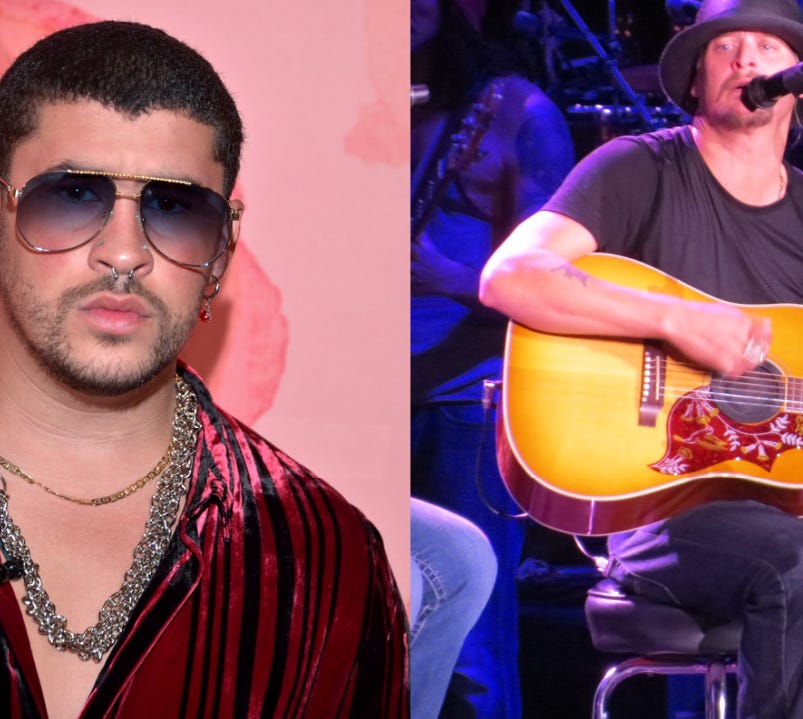
Most Americans, and presumably most of the Blue Tribe, watched the official Halftime Show, featuring Puerto Rican performer Bad Bunny. But some members of the Red Tribe rallied behind counterprogramming put on by the right-wing activist group Turning Point USA (their show was called “The ALL-AMERICAN Halftime Show.”)
The counterprogramming was spurred by the perception that having Bad Bunny — a Latino artist who has made no secret of the fact that he isn’t a big fan of Donald Trump’s immigration policies — was somehow diverting from mainstream American culture, which TPUSA sees itself as shepherding.
Some Republican Members of Congress even want there to be a federal investigation into Bad Bunny, while pundit Megyn Kelly protested the fact that so much of the Halftime Show was in Spanish instead of English:
Who gives a damn that we have 40 million Spanish speakers? We have 310 million who don’t speak a lick of Spanish! This is supposed to be a unifying event for the country. Not for the Latinos.
Missing the melting pot in the room

The problem with all these arguments about Bad Bunny vs. Kid Rock or how our entertainment should either be in English or Spanish is how divorced they are from the actual world of music.
Music has always served as one of America’s ultimate forms of melting pots. Kid Rock himself plays a guitar — an instrument whose predecessor was first developed in North Africa and whose modern form was pioneered in Spain.
Yes, Spanish-speaking Spain gifted the modern world the guitar. Everyone from the Beatles to Kid Rock can thank the Spaniards for the musical talents that made them household names. And if you look at the kind of music that Americans have gravitated towards, we have hardly been limited to the Anglosphere.
If you look at today’s Billboard Hot 100, which serves as a repository for the week’s top songs, you’ll find a list as diverse as the United Nations: Bad Bunny is one of the nation’s most listened to artists, but so are Taylor Swift, Bruno Mars, and the Korean folks who have been driving every parent in the country crazy with their single from KPop Demon Hunters.
(Kid Rock is nowhere in the top 100, for what it’s worth.)
Mind you, these are the top tracks in the United States, not globally. The kind of music that Americans like to listen to spans a wide range of cultures and languages. While Kelly may have the image in her mind of an America that’s still culturally aligned with Green Acres, that’s just not the kind of country that we live in anymore.
I know that’s scary for a lot of people because when things around you change you often feel like you’ve lost something. Human beings are social creatures, and we grow attached to our environments.
I don’t think rubbing into the faces of old white folks like Kelly and those older than her (basically: Donald Trump’s base) that the future of America will look totally different than what they grew up in is a very savvy move. That’s just kicking someone while they’re down.
The alternative I would suggest is just to draw skeptics into accepting diversity by pointing out that it has a lot of benefits. I mean, go and watch Bad Bunny’s Halftime Show. I don’t speak Spanish, and yet I have to admit that it was a banger.
I play guitar myself, and that means that I owe my own small musical talents to a diverse etymology. I’m playing a Spanish-Moorish instrument and picking up songs from a wide range of cultures.
The tunes I’ve learned come from cultures far removed from my own, and yet I don’t feel like I appreciate them any less. They include:
Aberdeen, a folk song written by Avi Kaplan, a Jewish American of Ukrainian and Russian family background.
Last of My Kind, a country song written and performed in part by Shaboozey, an artist whose parents are from Nigeria. (Here’s a joke I made on TikTok after learning it.)
A whole lot of stuff by First Aid Kit, an indie band that hails from Sweden.
Something you have to remember about human languages is that they’re just an attempt at getting across what we believe and what we feel. Music is another way to do so. And it transcends barriers like parochial languages, national borders, and political beliefs.
Music is the ultimate American melting pot, and this is a country more than big enough for both Bad Bunny and Kid Rock.
A valuable take on the Super Bowl controversy and the way our music culture exemplifies a cultural diversity some just haven't caught up to. A great irony of the crowning of Kid Rock as the moral alternative to the apparently "disgraceful" gyrations of Bad Bunny is that Rock himself borrows from a rock music shaped by the Spanish influences you mentioned not to mention African American blues and of course hip hop!
Also, Bad Bunny's lyrics are certainly no worse--and arguably far more supportive of human autonomy--than Kid Rock's. In Rock's 2001 song, “Cool, Daddy Cool," he raps, “Young ladies, young ladies / I like 'em underage, see / Some say that's statutory / But I say it's mandatory.”
The song, by the way, was included in the children’s animated film, “Osmosis Jones.”
But we didn’t need to drag up this lesser known song. As Republican leaders are calling for an “investigation” into Bad Bunny’s performance over his lyrics, Rock’s hit song, “Bawitdaba," which was featured in his alternative halftime show, references gang banging, prostitution, drug use, and pornography. (“And this is for the questions that don't have any answers / The midnight glancers and the topless dancers…For the shots of Jack and the caps of Meth… For the hookers all trickin' out in Hollywood.”)
If the reply here is that it's pedantic to interrogate Rock's lyrics in this song, maybe the same could be said of interrogating Bad Bunny's. Whatever we choose, let's at least be consistent.
I find both Kid Rock & Bad Bunny music near unlistenable. That said, many said the same about punk, heavy metal, grunge and rap in years past. I do love authentic music from across different genres and era’s- and yes, they all influence one another. I don’t think Kid Rock & Bad Bunny will stand the test of time. And if you like that music, then I’m sorry your tastes are so poor 🤷🏼