


The past few months have seen an avalanche of stories about Georgia GOP Congressman and U.S. Senate candidate Mike Collins and his ties to white nationalists.
These include the revelation that one of his former staffers was infatuated with Nazi and KKK imagery, his son-in-law is a white nationalist influencer, and his former chief of staff was in a racist group chat.
Collins for his part has tried to distance himself from these associations. “I’ve repeatedly said nobody speaks for me, I only speak for myself,” he recently told the press, adding that he has “always condemned racism and antisemitism regardless of the source.”
Politically speaking, it would behoove Collins to demonstrate to voters that he doesn’t share the views of his far-right former staffers and family members as he campaigns to unseat Georgia’s Democratic Senator Jon Ossoff. The Peach State is in the process of becoming majority-minority; pretty much all of the state’s population growth in the past six years is the consequence of growth in minority populations.
Yet in interviews with civic leaders from minority communities, I found that he has more or less been completely absent during this campaign.
“I have seen Ossoff at many Latino mainstream events. I have not noticed Collins at many at all,” Jerry Gonzalez, a longtime Latino politico and executive director of GALEO Impact Fund, told me. (The Fund has endorsed Ossoff.)
Nonpartisan organizations, too, said they haven’t seen or heard from Collins on the trail.
Shafina Khabani, the executive director of the Georgia Muslim Voter Project, told me she is unaware of any contact he’s had with the state’s growing Muslim community.
“Mike Collins has not reached out to our organization - I haven’t heard about him doing outreach to any other Muslim orgs in Georgia but unsure,” she said.
Even some conservative members of Georgia’s minority communities haven’t heard from Collins during this campaign.
Sunil Savili, an Indian businessman and the founder of Indian Friends of Atlanta who told me in the past that he leans conservative in his politics and who has attended at least one event with Georgia’s GOP Governor Brian Kemp, hasn’t seen Collins.
“No one reached me,” he said.
Some of Collins’s own constituents, too, have been in the dark.
Sarita Dyer, a retired U.S. Army Sergeant Major and black woman who lives in Collins’s district in Northeast Georgia, told me she’s never had much luck in getting his office to be responsive to his concerns. And she had no rapport with her congressman.
“We don’t bite! The black community don’t bite,” she told me, telling me that she’s seen campaign signs but that Collins hasn’t campaigned black constituents in her communities and she hasn’t seen him.
A look at Collins’s recent schedule reveals a campaign schedule fixated on the GOP base and an avoidance of minority neighborhoods, with the exception of the Morrow, GA stop which is south of Atlanta.
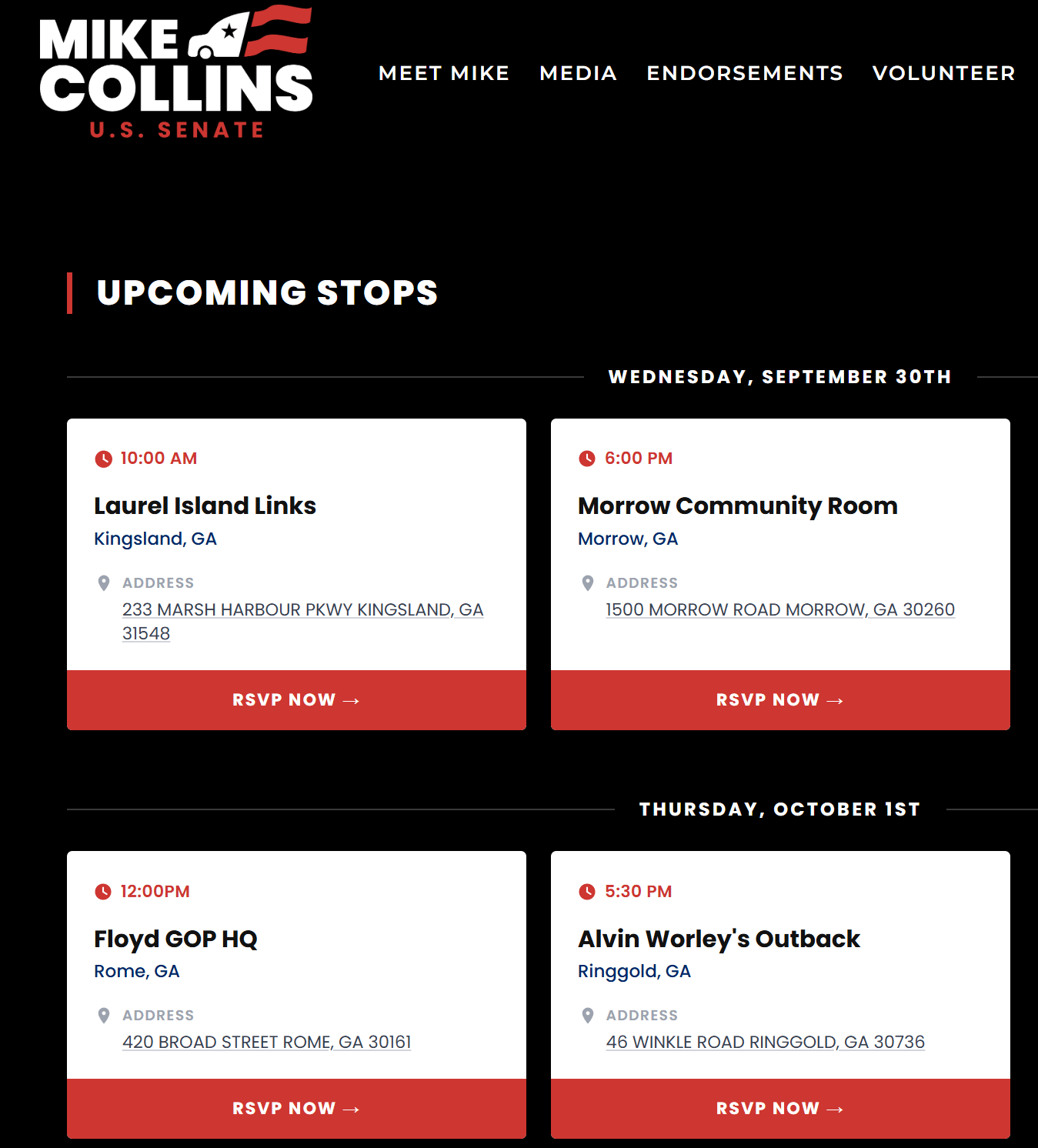

Collins’s campaign strategy differs from the other Republican at the top of the ticket: billionaire Rick Jackson, who is running for governor. Jackson has made a point of campaigning in diverse areas; he recently campaigned at the Korean Festival in Duluth, as one example.
That’s a marked contrast from Collins, who appears to be fixated on attending events where the only nonwhite person in the room is the help.
Collins’s campaign did not respond to multiple requests for comment.