


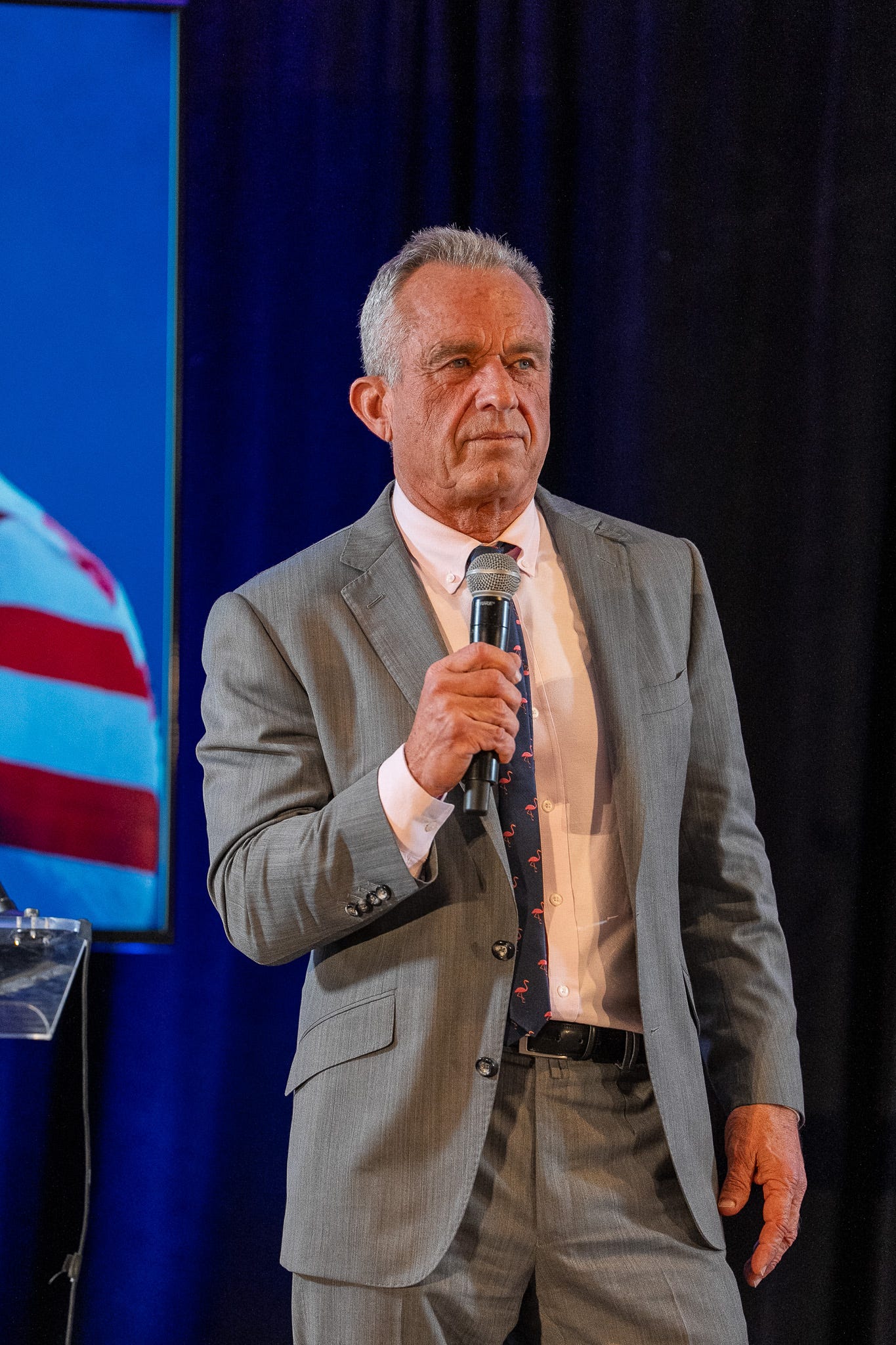
Health and Human Services (HHS) Secretary Robert F. Kennedy Jr. is remaking the government’s approach to autism, the neurodevelopmental disorder that impacts as many of 3 percent of American children.
In a sweeping move announced earlier this week, the HHS announced the appointment of 19 new members to what’s called the Interagency Autism Coordinating Committee, or IACC.
“The intention of this committee to advise the [National Institutes of Health] on how to spend autism research dollars — set priorities for research funding,” explained Amy Lutz, an historian of disability at the University of Pennsylvania who has written multiple books about autism and disabilities and has a minimally speaking autistic son herself.
The IACC has been around for two decades and has played a key role in helping guide autism research policy for the United States. If someone wanted to completely change the federal government’s approach to autism, there would be few places worse to start than the IACC.
And if the members named to the committee this week are any indication, RFK Jr.’s approach will radically differ from the mainstream. For one, it seems to offer a wholehearted embrace of controversial pseudoscientific communications method that advocates claim has transformed the lives of profoundly autistic people but which has also been tied to some of the most abusive cases in autistic treatment history.
A miracle technology that lets profoundly autistic people learn calculus in a day
Last year, RFK Jr. came under fire from some autism advocates for describing some autistic individuals as suffering so profoundly that they “will never pay taxes, they'll never hold a job, they'll never play baseball, they'll never write a poem, they'll never go out on a date. Many of them will never use a toilet unassisted.”
While Kennedy’s statement may have been hyperbolic, it is true that some people on the severe end of the autism spectrum — who typically cannot speak on their own or only repeat a few words at best — are so profoundly intellectually disabled that they cannot do these tasks.
These nonverbal autistic people usually require lifelong assistance of some kind.
You can hardly blame Kennedy, then, for aggressively searching not only for a cure for autism but also a way to help these nonverbal autistic people communicate.
Kennedy and his foundation, the Children’s Defense Fund, believed they had happened upon such a miracle cure a few years ago.
They helped promote a documentary called Spellers, a high production value film that can now be viewed on YouTube for free.
The premise of Spellers is simple. For years, the world has written off nonverbal autistic people as intellectually disabled. But maybe they are not suffering from an intellectual disability at all — maybe the thoughts inside their heads are no different than anyone else’s.
The key to unlocking those thoughts is handing these nonverbal individuals letter boards where they can slowly spell out their thoughts. Through techniques called , Rapid Prompting Method (RPM) or Spelling 2 Communicate (S2C) facilitators help these individuals, usually referred to as spellers, spell out their thoughts.
In RFK Jr.’s mind, these facilitated messages are nothing short of miraculous.
JB Handley, a former private executive and one of the co-producers and stars of Spellers, joined RFK Jr. for a virtual book event back in 2021.
Handley, whose son is nonverbal and uses S2C, regaled RFK Jr. with the story of how his son, who was written off as intellectually disabled, was actually brilliant once taught how to spell out his thoughts.
“He learned to do calculus and essentially a day and his calculus teacher said I can’t teach him anymore,” Handley told Kennedy. You need a college level teacher because he’s too fast.”
He also told the Kennedy scion that his son picked up foreign languages through osmosis. Kennedy sat transfixed, not questioning a word of it.
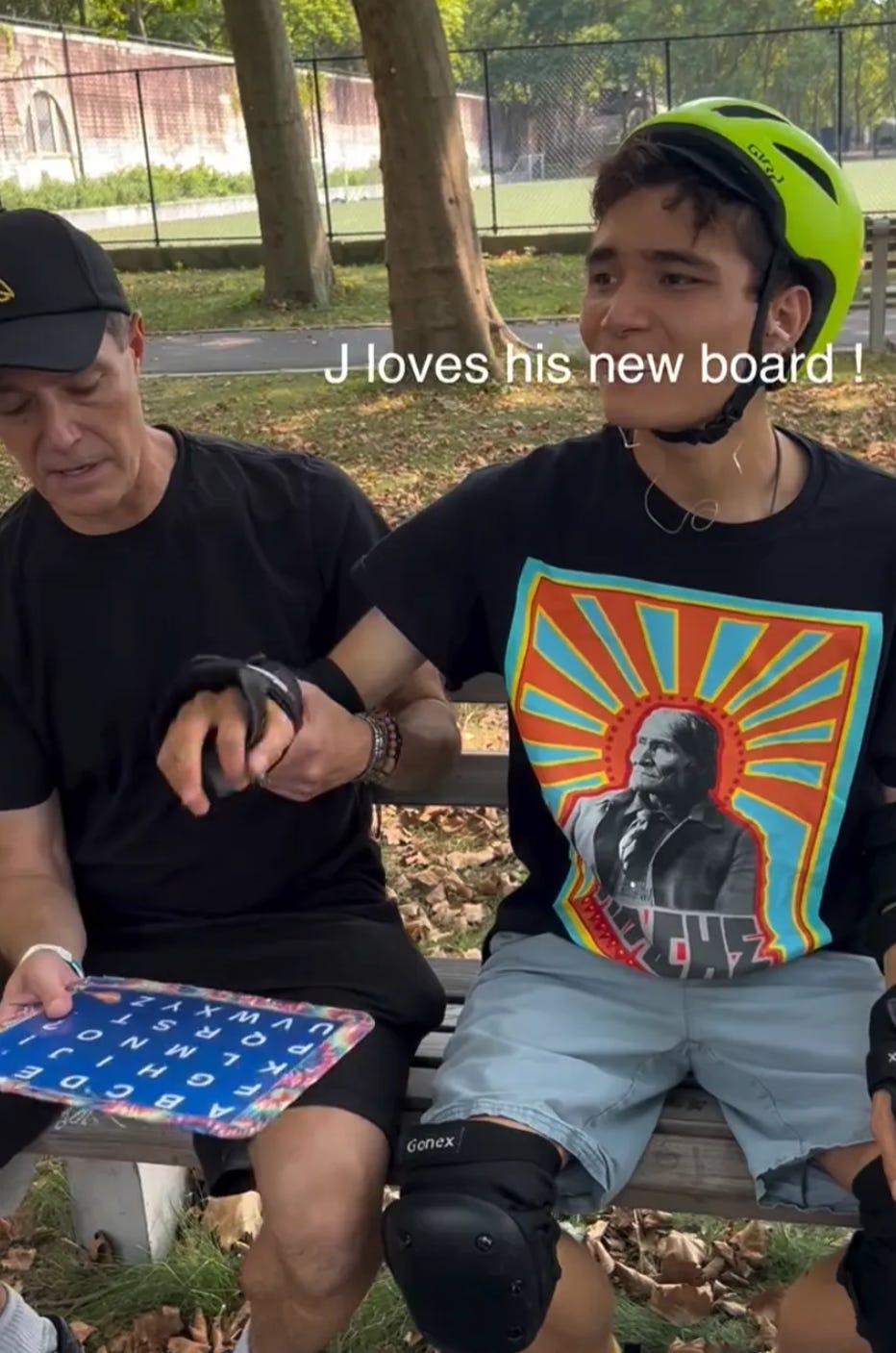
In the world of spelling, such stories are not uncommon. The image above comes from the Instagram of Marie Myung-Ok Lee, a novelist and Columbia who along with her fellow Ivy League husband picked up spelling as a way to help their son Jason communicate.
Things went from doctors telling her that her son had an IQ of just 40 to him writing complex essays and even auditing college classes. All thanks to a letterboard.
Thanks to RFK Jr., advocates for spelling now populate the IACC and will have a deep influence on how the government supports this method with taxpayer dollars.
The committee includes several prominent spelling advocates and practitioners like Katie Sweeney and Krystal Higgins. It also includes several nonspeaking adults like Caden Larson and Elizabeth Bonker, who were featured in Spellers. (A previous iteration of the IACC did include one speller as well.)
To advocates for spelling, this is a breakthrough moment. The federal government is finally putting its weight behind communications methods that they believe can unlock an entire world for nonverbal autistic people — prove to Americans that they are just as intelligent as anyone else.
But these methods have long alarmed autism researchers and advocates, who point to an obscure but important history.
Does spelling unlock the mind of the autistic person or the facilitator?

The letterboards that the spellers use find their origin in a technique called facilitated communication (FC).
In the latter half of the 20th century, a group of educators and therapists who worked with nonverbal children decided to help them type out their thoughts instead. The practice was popularized in Australia and soon made its way across the Pacific Ocean to the United States.
One of the FC practitioners who leapt head-first into the practice was named Janyce Boynton.
One day she was working with a student named Betsy Wheaton, whose story was later captured in the Frontline documentary “Prisoners of Silence.”
As she helped Wheaton type out her thoughts, she was horrified. She noticed that Betsy was acting out more and more, including with physical violence.
Boynton began to worry that Wheaton was being abused at home. And sure enough, she began to type out messages confirming those fears — accusing her entire family of sexually abusing her.
Betsy and her brother were removed from the family by the local authorities while they investigated.
But her parents denied the allegations and hired an expert, Dr. Howard Shane of Boston Children’s Hospital, to try to debunk the messages Betsy had been writing.
He came up with what’s called a “double-blind” exam to test the authenticity of the messages.
The test was simple: Betsy and her facilitator would be shown a series of objects. When they were shown different objects, we could see if Betsy, with the aid of her facilitator, would type out the picture she saw or the one her facilitator saw.
When Boynton participated in the test, she realized she couldn’t get the answers right when she didn’t see the object that the evaluator showed only to Betsy. It was that day that her faith in the process crumbled, as she wrote in her journal article years later:
I felt such devastation, panic, pain, loneliness—a myriad of emotions difficult to put into words. The whole FC thing unraveled for me that day, and I did not have an explanation for any of it. Almost immediately, I started rationalizing away the truth. Though it was not true, I went away from the testing telling myself that the situation had been hostile, the evaluator had been hostile, everyone had turned against me. Incredibly, I even tried facilitating with the child in the week or two after the testing, resulting in more outrageous and false allegations. The parents, understandably, asked that I no longer work with the child. I felt tremendous loss.
The Wheatons were reunited and Boynton turned against the practice of FC. The double-blind tests that Shane had used in her case became commonplace in studies of FC. To this day, there is not one scientific study that has validated its use. In every study, facilitators and their clients failed the double-blind testing — with researchers coming to the conclusion that it was the facilitators who were actually authoring the messages.
Researchers by and large did not come to the conclusion that the facilitators were acting in bad faith. Instead, they pointed to something called the ideomotor effect, a psychological process where people involuntarily move their bodies in response to their thoughts. The effect could explain not only why facilitators were unwittingly authoring these messages but also how people operate devices like Ouija boards.
In the years since the wave of debunking studies in the 1990s, FC has largely fallen out of favor. But new variations of a facilitator using a letterboard, like RPM and S2C, continue to proliferate.
There are differences between these newer methods and FC; FC practitioners generally touched the client and guided their hands or shoulders. Under RPM and S2C, practitioners typically hold up a letterboard instead.
But the danger of prompting and guiding students to type is still there, which is why American Speech-Language-Hearing Association and every mainstream autism organization opposes the use of spelling. Instead, they encourage the use of Augmentative and Alternative Communication (AAC) devices.
There are a range of AAC techniques and devices that nonverbal people have used to communicate. These can include writing, drawing, using gestures or facial expressions, pointing to pictures, or using apps on a tablet.
But advocates for spelling find these methods to be frustrating. They do not produce complex essays or treatises like what we’ve seen from spellers. Yet to this day, RPM and S2C techniques have never passed the simple test that Shane devised.
The dangers of government-backed spelling

But isn’t spelling worth investing in, even if it hasn’t been scientifically proven to work?
The problem, argues the mainstream autism community, is that if we can’t verify that spellers’ words are their own, we open up the possibility of abuse.
These include the case of a professor who molested a young man who she believed was spelling out his consent and a mother who murdered her child after she believed that he wanted to commit suicide.
The possibility of falsely gaining someone’s consent also raises a gamut of deep moral and ethical questions: Should someone be allowed to vote through the use of a facilitator who is helping them type out their thoughts? Should they be able to give consent for marriage? Can they write their own wills?
“These appointments contribute to the normalizing non-speaking autistics as having intact language and literacy skills—which not only conflicts with the evidence but negates the best practices and therapies that this extremely vulnerable group depends on,” Katharine Beals, an autism researcher at Drexel University and the mother of an autistic child herself, told me.
The worry for much of the mainstream autism community is that these appointments will steer the federal government towards supporting unproven communications techniques while starving legitimate research of funding.
"The concern is that we’ll be taking hundreds of millions of dollars and basically incinerating it in pursuit of completely unscientific alternative therapies and already debunked theories of autism causation,” Lutz said.
Lutz is the mother of a nonverbal child herself. The issue is deeply personal for her.
“At the profound end of the spectrum where my family is, our kids are in desperate need of better interventions, long term supports and services,” she said.
The msm hitjob slop of RFK is among the most sloppy
I looked at part of the PhD thesis of one of his appointees...it was bad:
https://thescamdoctor.substack.com/p/toby-rogers-phd-thesis-is-wrong-about?r=6hgshq