



Earlier this month, I caught a screening of Naza, a new Israeli documentary that has netted major applause from critics and prestigious film festivals.
The film, helmed by Yuval Abraham and Rachel Szor, is a sort of follow up to their previous documentary, No Other Land, which won an Oscar in 2024. While No Other Land featured Abraham encamped in an endangered Palestinian village in the West Bank, Naza focuses on Israel’s other theater of combat in Gaza.
The film’s title comes from the word Israelis use to describe civilian combat deaths. Its narrative is based off of a series of articles Abraham reported in the Israeli press shortly after the onset of the war in Gaza. In those articles, Abraham interviewed Israeli intelligence officials to explore how Israel had dramatically loosened their standards of civilian protection.
While much of the content of the film is covered in those pieces, what’s striking about the documentary is how we see and hear Israeli officers describe in their own words what they did during the war in Gaza.
Abraham sets the documentary on the rooftops of Tel Aviv. The Israeli officers interviewed are shot silhouette style so that we can’t see their faces; their voices are also digitally altered. If you think that these measures are extreme, recall that Israeli leader Benjamin Netanyahu has called for Abraham and Szor to lose their Israeli citizenship for producing the film. Imagine what they’d do to Israeli officers describing in detail how the military’s sausage is made.
This anonymity allows the officers to speak candidly. They describe using artificial intelligence to paint targets with little confidence, taking part in air strikes where hundreds of civilian casualties were okayed, and intentional attacks on unarmed civilians. While the officers speak, Abraham and his camera crew often illustrate their words with scenery of apartments and communities in Tel Aviv.
The message isn’t subtle; as Israeli officers speak of wiping out entire families and neighborhoods in an attempt to take down a Hamas operative, we can imagine the horror from Israelis if similar tactics were deployed in modern Tel Aviv.
But what stood out to me about the testimonies is not just the brutality of what they witnessed and, in some cases, committed in Gaza. The officers appear to be genuinely reflective about what they had taken part in; many feel deep guilt or at the very least are conflicted about the necessity of their tactics and the morality of the broader Israeli strategy in Gaza. One officer even talks about visiting Eastern Europe to learn about the horrors of the Final Solution and begins to wonder if he was involved in a similar project in Gaza.
Unfortunately, there is little evidence the broader Israeli public is willing to be similarly self-reflective. Netanyahu’s campaign against Naza is taking place under a backdrop where many in the country view the filmmakers as traitors who are undermining the country’s just struggle against Hamas and other threats to the Israeli public.
Here in the United States, a distributor has finally stepped up to give the film a broader release after its strong initial showing at the box office. It’s not surprising that Americans may be more open to the film’s message than Israelis; the atrocities in Naza were committed by Israeli soldiers, not American ones (although it should be said that American taxpayers played a significant role in enabling Israel’s onslaught in Gaza).
But Israelis who refuse to see the film or even worse would join Netanyahu in accusing the filmmakers of treason would do well to imagine what their society will eventually become if they refuse to face reality. That’s the subject of another documentary that was released fourteen years prior.
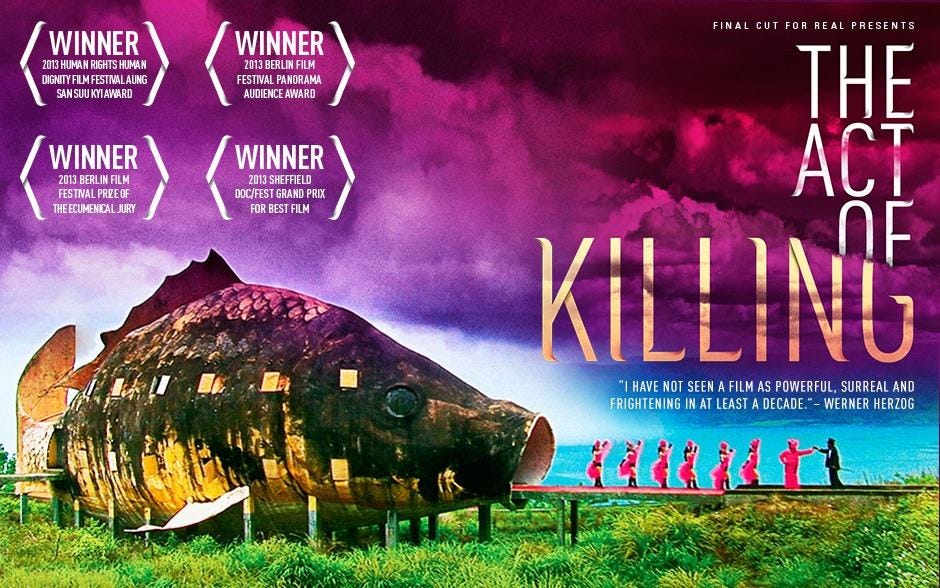
The 2012 film The Act of Killing isn’t about any contemporary war or atrocity. Instead, director Josh Oppenheimer traveled to Indonesia and decided to interview people across the country who had been involved in that country’s mass crackdown on communists and other left-wing sympathizers in the 1960’s.
That crackdown involved mass violence on a scale we normally associate with horrors like the Armenian Genocide. The Holocaust museum in Houston, Texas, even includes a section on the killings in its education materials; those killings involved the deaths of anywhere between 200,000 and a million people.
But like Abraham, Oppenheimer arrives in Indonesia not to focus on the victims but the perpetrators. What was going through the minds of these people as they calmly detained, tortured, and executed thousands upon thousands of people based off of their political beliefs? To add a grim layer to the film, some of the perpretrators even re-enact their atrocities.
The biggest difference between the subjects in Naza and the ones in Killing, however, is how they feel about what they did. While the Israeli officers are either conflicted or repentant, most of those interviewed in Killing are defensive of or even proud of what they did.
One factor that may explain the difference in response is time. Israel’s wars in the Middle East remain highly controversial and dominate the airwaves in the global media; Israel’s Prime Minister Benjamin Netanyahu is the subject of an international arrest warrant.
On the other hand, the mid-20th century atrocities in Indonesia have largely been forgotten. While there’s a possibility that Israelis guilty of war crimes and crimes against humanity in Gaza will be punished or at least stigmatized, no such consequence is expected for the crimes in Indonesia.
But if the world moves on from Gaza and simply shrugs at the laboratory of mass killing that the territory was subjected to, we may expect that decades from now a filmmaker will interview gray-haired Israeli veterans that are happy to re-enact the crimes they committed against Palestinians. Ultimately, it is accountability that prevents crime; without deterrence, people are not only unafraid to commit horrors, they may even find themselves boasting about them in the future.